
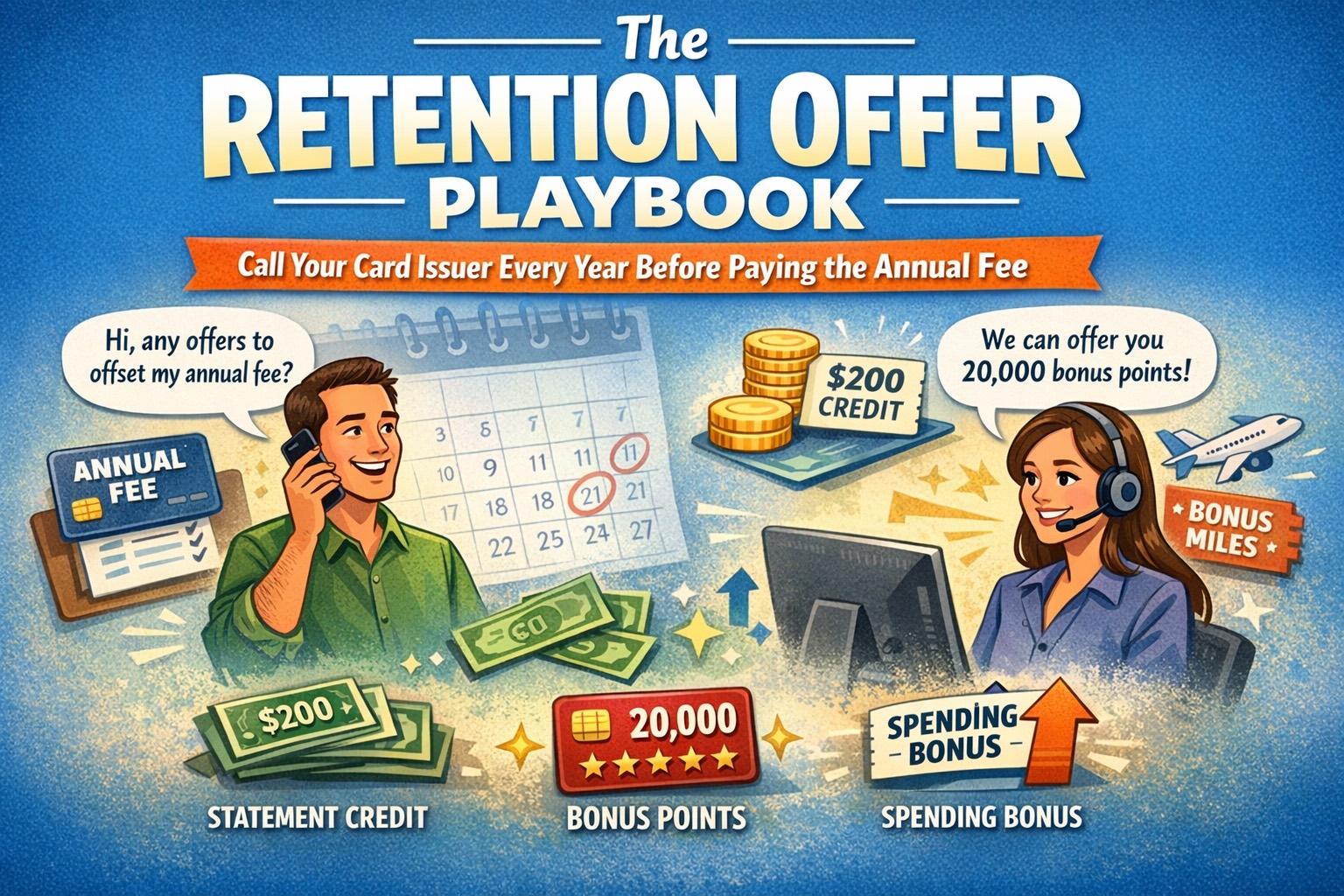
The Retention Offer Playbook: Call Your Card Issuer Every Year Before Paying the Annual Fee
How to call or chat with your card issuer each year and walk away with bonus points, statement credits, or spending bonuses that offset your annual fee — or more.
Verify this article against the current numbers.
Articles explain the strategy; CardCurator's live card, transfer-bonus, and award-chart pages are the source to check before you apply, transfer points, or book.
Every year, right before your credit card annual fee hits, there's a window most cardholders completely ignore. A quick phone call or chat session — ten minutes, tops — can result in hundreds of dollars in bonus offers. Issuers want to keep you. Use that leverage.
I just went through this myself with the Capital One Venture X. After reaching out, I was offered a $200 Capital One Travel credit for spending $2,000 within 3 months. That's $200 in travel value on top of the card's existing $300 travel credit and anniversary bonus — effectively turning a $395 annual fee into a net positive for another year.
What Is a Retention Offer?
A retention offer is a targeted incentive a card issuer presents to keep you as a customer. When you signal that you're thinking about canceling — or simply ask what they can do for you before you pay another annual fee — the issuer's retention team has the authority to extend special offers not available through any other channel.
These offers typically come in a few forms:
- Statement credits — Direct credit applied to your account
- Bonus points/miles — Lump-sum deposit to your rewards balance
- Spending bonuses — "Earn X bonus points/credits after spending $Y in Z months"
- Annual fee waiver — The fee is reduced or waived entirely for another year
Not every call produces an offer, and not every offer is worth it. But the process costs you nothing except a few minutes.
When to Make the Call
The best time to call is in the 30-day window before your annual fee posts. You're most likely to get an offer when the issuer can see the renewal coming. Calling within 30 days after the fee posts works just as well — issuers can apply a credit retroactively once you agree to keep the card, and in some cases the post-fee window actually produces better offers since the renewal is already locked in.
Mark your annual fee date in your calendar. Set a reminder two weeks out.
The Script: What to Actually Say
You don't need to be confrontational or threaten to cancel. Direct and honest works fine:
"Hi, my annual fee is coming up and I'm evaluating whether to keep the card. Is there anything you can offer to help offset the fee?"
That's it. The rep will either check your account and extend an offer, or they'll say they don't have anything available right now. If they come back empty, you can ask:
"Is there a better time to call? Or is there a retention department I should be transferred to?"
If you're truly on the fence about keeping the card, it's fine to say that. Honesty helps — reps can see your spending history and will make a judgment call on whether you're worth retaining.
Live Chat Works Too
Capital One, Chase, Amex, and most major issuers let you do this entirely through their app or website chat. Same script, same outcome — and sometimes easier if you prefer not to make a phone call. In my experience, Capital One required a phone call, while Amex came through instantly via app chat. Know going in which channel your issuer uses.
What a Good Retention Offer Looks Like
Here's how to evaluate whether an offer is worth accepting:
For premium cards ($400+ annual fee):
A good offer covers at least 25–50% of the annual fee in incremental value. If your card already breaks even through its standard benefits, any retention offer is pure bonus.
For mid-tier cards ($95–$250 annual fee):
An offer equal to 50–100% of the fee is solid. A $95 annual fee offset by an $80 statement credit makes keeping the card a near-no-brainer.
For no-annual-fee cards:
These rarely come with retention offers since there's no fee pressure, but bonus points offers do occasionally appear.
Real Examples from My Own Wallet
Capital One Venture X (phone call required)
- Annual fee: $395
- Offer received: $200 Capital One Travel credit after spending $2,000 in 3 months
- Net effect: $200 in travel value on top of the card's existing $300 travel credit and 10,000 anniversary bonus miles — the fee more than pays for itself
Amex Business Gold (app chat, took minutes)
- Annual fee: $375
- Offer received: 80,000 Membership Rewards points after spending $15,000 in 3 months
- Net effect: At ~2¢ per point, that's ~$1,600 in potential value from a $375 fee — an obvious keeper if you can hit the spend
The Amex Business Gold offer is a great illustration of why chat is worth trying even for premium cards. The spend requirement is higher, but for a business owner running normal expenses through the card, 80k points is transformative value.
Cards With Strong Retention Track Records
While offers vary by account, spending history, and timing, these issuers and cards are known for meaningful retention offers:
American Express
Amex has one of the best retention programs in the industry. Offers range widely — Platinum and Gold cardholders commonly see 10,000–30,000+ Membership Rewards points, while Business Gold can come in significantly higher (I received an 80,000-point offer). The Delta co-brand cards frequently offer statement credits or bonus miles. Amex retention is typically handled through app chat, which makes the process especially painless.
Chase
Sapphire Reserve and Sapphire Preferred holders regularly report statement credits or bonus Ultimate Rewards points. Chase is less aggressive than Amex but still worth the call.
Capital One
Venture X holders increasingly report solid offers — spending bonuses for travel credits are a common format. The Venture and Venture One cards also see offers, though typically smaller.
Citi
Citi Strata Premier and Prestige (when it existed) holders have had success. Citi offers tend to be point bonuses after meeting a spend threshold.
Bank of America
Premium Rewards and Travel Rewards cardholders occasionally get annual fee credits or point bonuses, though BOA's retention program is less reliable than the big three.
What Happens If They Say No
Not every account qualifies. Factors that reduce your odds:
- You haven't used the card much in the past year
- You've already received a retention offer recently
- You're calling too early (more than 60 days before the fee)
- The card you're calling about rarely has targeted offers
If you get no offer, you still have options:
- Call back in a week. Retention offers can appear or disappear based on what the issuer is running at that moment.
- Ask about a product change. If the card no longer makes sense, you can often downgrade to a no-fee version and preserve your credit history.
- Cancel if the math doesn't work. There's no shame in it. The right call is whatever makes financial sense for your situation.
The Broader Strategy: Build This Into Your Annual Routine
The most effective approach is to systematize this across your whole wallet. Each year, before every annual fee posts:
- List all cards with upcoming annual fees and their renewal dates
- Calculate current value — are you getting enough from standard benefits alone?
- Call or chat for any card where the math is close or where you want extra value
- Decide: keep, downgrade, or cancel based on what's offered
This annual review pays off in two ways: you capture retention offers you'd otherwise miss, and you avoid mindlessly paying fees on cards that have stopped earning their keep.
Bottom Line
Card issuers spend significant money to acquire new customers. Keeping an existing one costs them far less — which is why they're willing to pay to retain you. Retention offers are one of the most underused levers in the points-and-miles world, and the barrier to access is nothing more than a quick message or phone call.
Make it a habit. Your wallet will thank you.
Have a retention offer story? The best data on what's actually being offered comes from cardholders sharing their experiences. Keep track of what you receive year over year — patterns emerge.