
Citi Diamond Preferred Review 2026: Balance-Transfer Terms to Check
Citi Diamond Preferred review: understand the current introductory APR, balance-transfer fee, transfer window, and payoff plan before applying.
Verify this article against the current numbers.
Articles explain the strategy; CardCurator's live card, transfer-bonus, and award-chart pages are the source to check before you apply, transfer points, or book.
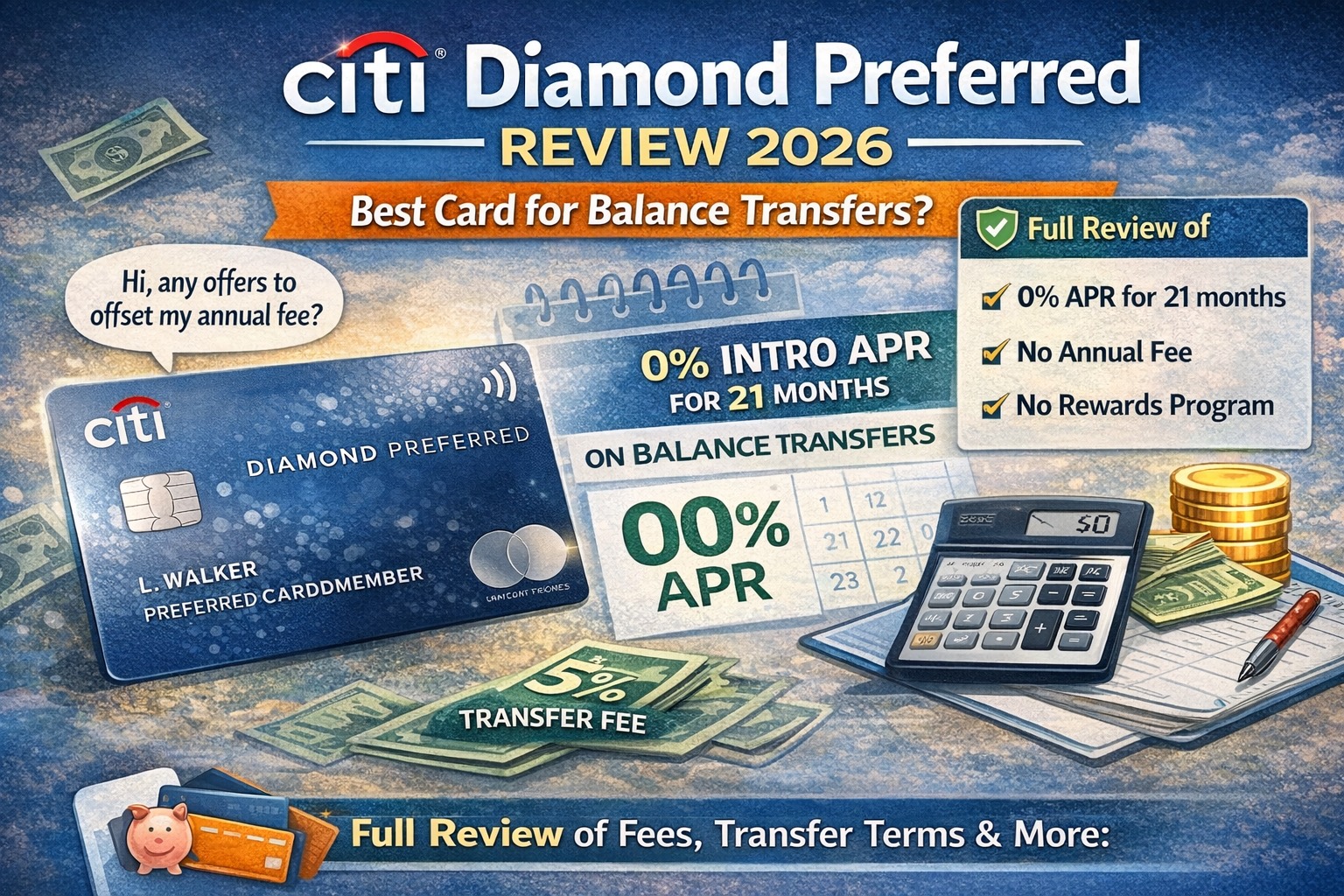
The Citi Diamond Preferred is not a rewards card. It earns no points or cash back. What it offers instead is a promotional balance-transfer rate; for someone carrying high-interest debt, a carefully used introductory offer can be worth more than a rewards card.
Here is the honest picture of what this card does, what it costs, and when it makes sense.
Card Details
Annual fee: $0
Intro APR on balance transfers: Check the offer and pricing disclosure shown during your application. Citi describes this as its longest-lasting introductory balance-transfer rate and requires transfers within the stated opening window.
Intro APR on purchases: Confirm the offered rate and duration before applying.
Regular APR: Variable after the promotional period; review the pricing disclosure for the rate assigned to you.
Balance transfer fee: Citi discloses the current introductory and standard transfer fees during the application process.
Foreign transaction fee: 3%
Track the Citi Diamond Preferred on CardCurator
Get alerts for credits, bonus milestones, and annual fee renewals — free.
The Balance Transfer Math
The pitch is straightforward: move high-interest debt only if the offered transfer fee and promotional period give you a realistic payoff path.
The transfer fee becomes part of the new balance, so calculate from the disclosure rather than assuming a universal percentage. Divide the transferred balance plus fee by the promotional months; if that payment is not realistic, an introductory offer is not a solution on its own.
Where it gets complicated:
You need a plan to pay it off. The promotional period is finite. When it ends, the remaining balance is subject to the card's variable APR. Divide the balance plus fee by the actual promotional months in your offer.
The transfer fee adds to the balance. If you transfer $5,000, the fee ($250) is added to the card balance, so you're starting at $5,250. Factor that into your payoff math.
Minimum payments won't cut it. The required minimum payment is much lower than what you'd need to pay off the balance before the intro period ends. Don't rely on the minimum.
How It Compares to the Wells Fargo Reflect
The other major long-0%-APR card is the Wells Fargo Reflect, which offers 0% intro APR for 21 months on both purchases and balance transfers, with a potential extension. The Reflect's balance transfer fee is also 5% ($5 minimum) after the first 120 days.
For most balance transfer situations, the two cards are nearly identical in cost and value. The main difference:
- Citi Diamond Preferred has a longer purchase APR intro period relative to Reflect's standard terms
- Wells Fargo Reflect offers a slightly more user-friendly mobile app and stronger fraud protections in some users' experience
Neither earns rewards, so this is purely a debt payoff decision.
Compare Citi Diamond Preferred vs Wells Fargo Reflect →
How It Compares to the Citi Simplicity
Citi's other no-rewards card, the Citi Simplicity, is positioned similarly but with one difference: no late fees and no penalty APR. If you're worried about missing a payment, that's meaningful protection. The Simplicity typically has a shorter intro APR period than the Diamond Preferred, so if your priority is maximizing the 0% window, the Diamond Preferred usually wins.
Compare Citi Diamond Preferred vs Citi Simplicity →
Who This Card Is For
Good fit if:
- You have $2,000+ in credit card debt at 18%+ APR
- You can commit to a monthly payoff plan for 21 months
- You qualify for the card (generally requires good to excellent credit)
Not a good fit if:
- You want rewards on ongoing spending (get a rewards card instead)
- You're unlikely to pay off the balance before 21 months (the rate reset will hurt)
- You need to transfer from another Citi card (Citi doesn't allow transfers between its own products)
The Trap to Avoid
The most common mistake with balance transfer cards is treating the 0% period as a reason to keep spending on the card. New purchases during the intro period also get 0% for 12 months — but once that period ends, payments are applied to the lowest-APR balance first. If you've accumulated new purchases and haven't paid off the balance transfer, you can end up in a worse position than when you started.
Use this card for the balance transfer. Buy things on a different card — ideally one with rewards.
Bottom Line
The Citi Diamond Preferred is a focused tool, not a rewards card. It can be a reasonable option for high-APR debt when the disclosed transfer fee, promotional period, and required monthly payment work together. Read the application pricing disclosure before treating any published term as current.
See how it stacks up:
- Citi Diamond Preferred vs Wells Fargo Reflect
- Citi Diamond Preferred vs Citi Simplicity
- Citi Diamond Preferred vs Chase Slate
Track your cards and payoff progress on Card Curator.