
Prime Visa vs Amazon Visa (2026): 5% With Prime or 3% Without
Prime Visa vs Amazon Visa: 5% back with an eligible Prime membership or 3% without. Compare Amazon, Whole Foods, Chase Travel, and everyday rewards.
Verify this article against the current numbers.
Articles explain the strategy; CardCurator's live card, transfer-bonus, and award-chart pages are the source to check before you apply, transfer points, or book.
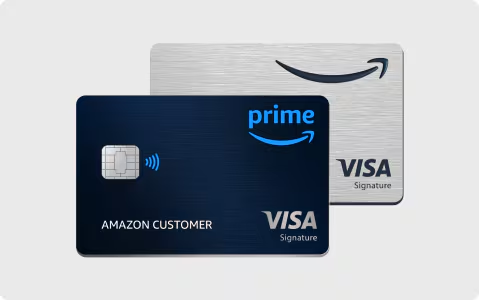
The real choice is simple: an eligible Prime membership earns 5% back with the Prime Visa, while the no-Prime Amazon Visa earns 3% back at Amazon, Whole Foods, participating Amazon stores, and Chase Travel. Both cards earn 2% at gas stations, restaurants, and local transit, with no annual card fee.
Choose the Prime Visa when you already value Prime. Choose the Amazon Visa when you do not want a Prime membership but still want stronger Amazon rewards than a flat-rate card provides.
The Two Amazon Cards at a Glance
Chase issues two Amazon co-branded credit cards with very different value propositions:
Prime Visa - Requires Prime membership but earns 5% back on Amazon and Whole Foods. The premium choice for Prime members.
Amazon Visa - No Prime required, earns 3% back on Amazon. Better for occasional Amazon shoppers.
Both cards have no annual fee and no foreign transaction fees. The key difference? Your Prime membership status.
Prime Visa: The 5% Powerhouse
The Prime Visa is the flagship Amazon card and delivers serious value for Prime members:
Earning Structure
| Category | Earn Rate |
|---|---|
| Amazon.com (with Prime) | 5% back |
| Whole Foods Market | 5% back |
| Audible.com (with Prime) | 5% back |
| Chase Travel | 5% back |
| Restaurants | 2% back |
| Gas Stations | 2% back |
| Transit & Commuting | 2% back |
| Everything Else | 1% back |
Key Benefits
- No annual fee - Free to hold forever
- No foreign transaction fees - Great for international travel
- Amazon purchase protection - Extended warranty and return protection
- Instant approval - Get a temporary card number immediately to start shopping
The Prime Requirement
Here's the catch: You must have an active Prime membership to earn 5% back. Without Prime, your earn rate drops to 3% on Amazon purchases.
If you are considering Prime solely for the extra 2% card reward, divide the current annual Prime price by 0.02 to estimate your own break-even spend. That is a secondary consideration: shipping, video, and other Prime benefits should drive the membership decision first.
Amazon Visa: The No-Prime Alternative
Don't have Prime? The Amazon Visa still delivers solid value:
Earning Structure
| Category | Earn Rate |
|---|---|
| Amazon.com | 3% back |
| Amazon Fresh | 3% back |
| Whole Foods Market | 3% back |
| Chase Travel | 3% back |
| Restaurants | 2% back |
| Gas Stations | 2% back |
| Transit & Commuting | 2% back |
| Everything Else | 1% back |
Key Benefits
- No annual fee
- No Prime membership required
- No foreign transaction fees
- Same 2% categories as Prime Visa (gas, dining, transit)
When Amazon Visa Makes Sense
The Amazon Visa is your card if:
- You shop on Amazon occasionally but aren't a Prime member
- You spend less than $5,000/year on Amazon
- You want Amazon rewards without the $139 Prime commitment
Head-to-Head Comparison
| Feature | Prime Visa | Amazon Visa |
|---|---|---|
| Annual Fee | $0 | $0 |
| Amazon Earn Rate | 5% (Prime required) | 3% |
| Whole Foods | 5% | 3% |
| Restaurants | 2% | 2% |
| Gas Stations | 2% | 2% |
| Transit | 2% | 2% |
| Base Rate | 1% | 1% |
| Prime Required | Yes | No |
| Foreign Transaction Fee | None | None |
See the full Prime Visa vs Amazon Visa side-by-side comparison →
Real-World Value Comparison
Let's see how these cards stack up with actual spending:
Scenario: $500/month Amazon Spend ($6,000/year)
| Card | Annual Rewards | Net Value |
|---|---|---|
| Prime Visa | $300 (5%) | $300 |
| Amazon Visa | $180 (3%) | $180 |
| Difference | $120 | If Prime = $139, Amazon Visa wins |
Scenario: $1,000/month Amazon Spend ($12,000/year)
| Card | Annual Rewards | Net Value |
|---|---|---|
| Prime Visa | $600 (5%) | $600 |
| Amazon Visa | $360 (3%) | $360 |
| Difference | $240 | Prime Visa wins even after $139 fee |
The tipping point: Use the current Prime price divided by 2% to calculate the point where the extra card reward alone offsets membership cost. Recheck that price before applying because Prime pricing can change.
If your household splits spend between Amazon and Walmart, read our Walmart OnePay review too. The two cards solve a very similar problem with different membership math.
Maximizing Your Amazon Card
Strategy 1: Stack with Amazon Subscribe & Save
Both cards earn full rewards on Subscribe & Save orders. Set up recurring purchases for household essentials and earn 3-5% back automatically.
Strategy 2: Use Whole Foods Strategically
Prime Visa earns 5% at Whole Foods—one of the highest grocery earn rates available without a category bonus card. Even without Prime, the 3% on Amazon Visa beats most flat-rate cards.
Strategy 3: Don't Forget the 2% Categories
Both cards earn 2% on gas, restaurants, and transit. That's competitive with dedicated 2% cards, making these solid everyday options.
Strategy 4: Book Travel Through Chase
Both cards earn elevated rates (5% or 3%) when booking through Chase Travel. If you're not earning toward a specific travel program, this is decent value.
Who Should Get Each Card?
Get the Prime Visa if:
- You already have Prime membership
- You spend $7,000+ annually on Amazon
- You shop at Whole Foods regularly
- You want the highest possible Amazon earn rate
Get the Amazon Visa if:
- You don't have Prime and don't want it
- You spend less than $5,000/year on Amazon
- You want solid Amazon rewards without commitment
- You're not sure if Prime is worth it for you
Skip Both Cards if:
- You rarely shop on Amazon
- You have a 2% flat-rate card that already covers your needs
- You're focusing on travel rewards (look at Chase Sapphire instead)
Card Curator Take
The Amazon cards are highly specialized tools. They're the best option for Amazon and Whole Foods spending, period. But they're not going to be your only card.
The good: No annual fee + 5% back on the world's largest retailer is genuinely excellent. The 2% categories (gas, dining, transit) are a nice bonus that most store cards don't offer. And here's what people overlook—even without Prime, the 3% earn rate is fantastic for a no-annual-fee card. You're beating most general cashback cards on one of the most-used retailers in the world.
The bad: Outside of Amazon/Whole Foods/the 2% categories, these cards are average. The base 1% rate means you need a complementary card for other spending.
The bottom line: If you already have an eligible Prime membership and buy regularly from Amazon or Whole Foods, the Prime Visa's 5% rate is compelling. Without Prime, the Amazon Visa's 3% rate can still beat a flat-rate card on eligible purchases. Skip both if Amazon spend is occasional or a different card better fits your overall wallet.
Frequently Asked Questions
Is the Prime Visa worth it without Prime?
No. Without Prime, the Prime Visa earns only 3% on Amazon—the same as the Amazon Visa. There's no benefit to holding the Prime Visa without an active Prime membership.
Can I downgrade from Prime Visa to Amazon Visa?
Yes. If you cancel Prime, you can request Chase convert your Prime Visa to the Amazon Visa. Your credit line and account age will be preserved.
Do Amazon card rewards expire?
No. Points earned on Amazon cards don't expire as long as your account is open and in good standing.
Can I use Amazon rewards for anything besides Amazon?
Yes. Rewards can be redeemed for statement credits, Amazon purchases, or gift cards. However, Amazon checkout is the most convenient redemption method.
Is there a signup bonus?
Both cards occasionally offer signup bonuses, typically in the form of Amazon gift cards ($100-$200). Check the current offer before applying.
Which card is easier to get approved for?
Both cards have similar approval requirements. Amazon cards are generally considered easier to get than premium Chase cards like the Sapphire products.
Use Card Curator to track your Amazon rewards and find the best card for every purchase—not just Amazon.
Disclosure: Card terms and benefits are subject to change. Always verify current offers on Chase and Amazon. This is educational content, not personalized financial advice.