
Aeroplan Award Chart Update 2026: What Changed on June 1 and Where Prices Moved
Air Canada changed the Aeroplan flight reward chart on June 1, 2026. Here are the routes that got cheaper, the zones that got worse, and what is now updated in Card Curator.
Verify this article against the current numbers.
Articles explain the strategy; CardCurator's live card, transfer-bonus, and award-chart pages are the source to check before you apply, transfer points, or book.
Air Canada's latest Aeroplan award-chart update took effect on June 1, 2026. The change is not a full-program rewrite, but it is still meaningful. Some short and mid-band awards got cheaper, several premium-cabin partner awards got more expensive, and the practical takeaway is the same as always: Aeroplan is still useful, but some of its best-value redemptions now require more points than they did before.
This post covers the official June 1, 2026 changes, what did and did not move, and how the updated pricing now appears in Card Curator's Aeroplan data.
Official sources:
The Short Version
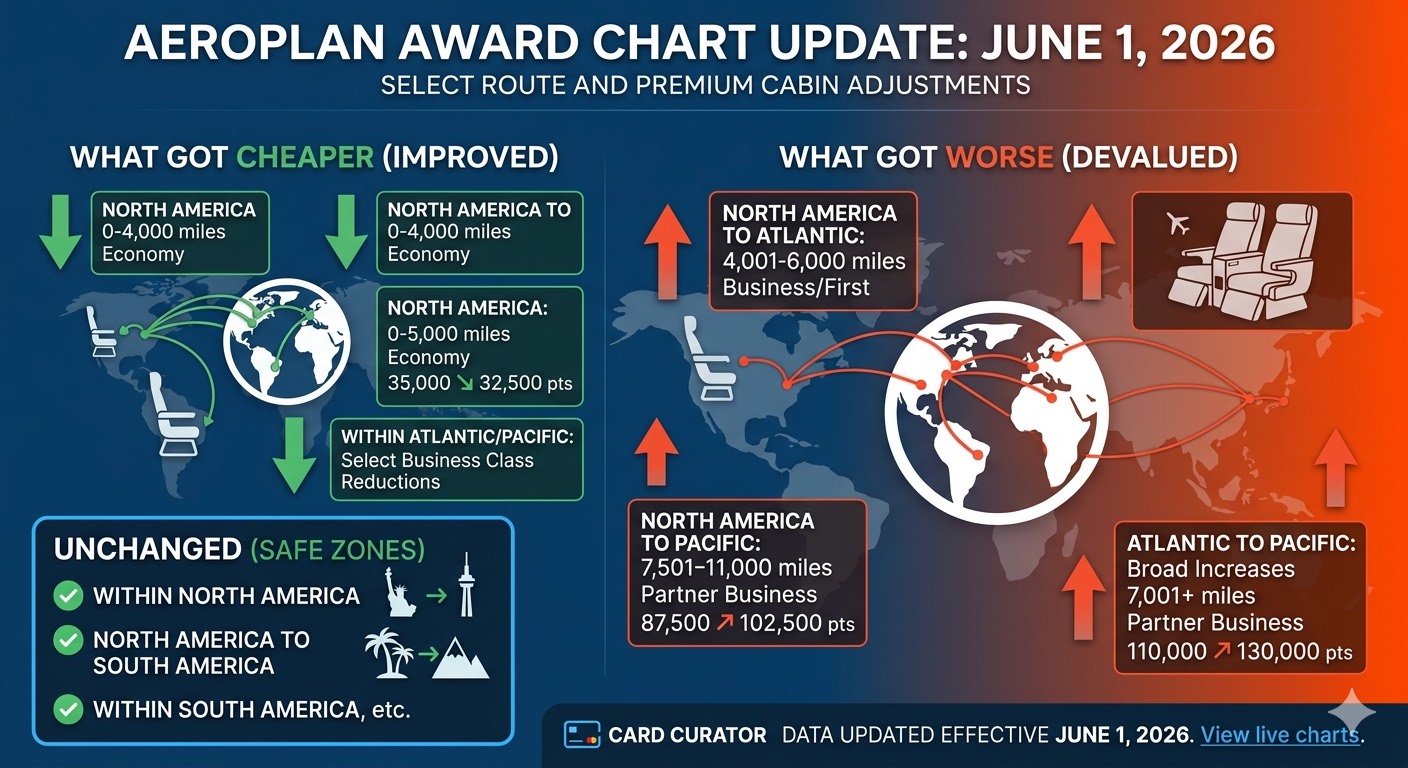
The June 1 update was a targeted repricing, not a universal devaluation. Air Canada explicitly published a list of changed bands, and those changes mostly hit five parts of the chart:
- North America to Atlantic
- North America to Pacific
- Within Atlantic
- Within Pacific
- Atlantic to Pacific
Several routes and cabins stayed the same, including:
- Within North America
- North America to South America
- Within South America
- Atlantic to South America
- Pacific to South America
That distinction matters. If you only saw headlines about an Aeroplan devaluation earlier this spring, the practical reality is narrower: some of the most commonly discussed long-haul sweet spots worsened, but large chunks of the chart did not change at all.
What Got Cheaper
There were real price cuts, though most were modest and selective.
North America to Atlantic
- 0-4,000 miles in economy dropped from 35,000 to 32,500 points
This is one of the better changes in the update because it affects short transatlantic itineraries that many people actually book, especially from the East Coast to Western Europe.
North America to Pacific
- 0-5,000 miles in economy dropped from 35,000 to 32,500 points
- 11,001+ miles in partner economy dropped from 75,000 to 70,000 points
That first cut is meaningful for shorter Pacific-zone itineraries. The second is more niche, but still real.
Within Atlantic
- 0-1,000 miles in business dropped from 15,000 to 12,500 points
- 1,001-2,000 miles in business dropped from 25,000 to 22,500 points
- 2,001-4,000 miles in business dropped from 45,000 to 40,000 points
If you use Aeroplan for intra-Europe or nearby regional premium-cabin flights, this is the cleanest good news in the update.
Within Pacific
- 5,001-7,000 miles in partner economy dropped from 37,500 to 35,000 points
- 7,001+ miles in economy dropped from 55,000 to 50,000 points
- 7,001+ miles in business dropped from 90,000 to 85,000 points
These are helpful, though they do not fully offset the increases elsewhere in the same zone.
What Got Worse
This is where the bigger story lives. The most painful changes are concentrated in premium cabins and partner first class.
North America to Atlantic
- 4,001-6,000 miles in economy rose from 40,000 to 42,500
- 4,001-6,000 miles in business rose from 70,000 to 75,000
- 4,001-6,000 miles in partner first rose from 100,000 to 120,000
- 6,001-8,000 miles in partner economy rose from 55,000 to 60,000
- 6,001-8,000 miles in business rose from 85,000 to 90,000
- 6,001-8,000 miles in partner first rose from 130,000 to 150,000
- 8,001+ miles in partner economy rose from 70,000 to 75,000
- 8,001+ miles in business rose from 100,000 to 110,000
- 8,001+ miles in partner first rose from 140,000 to 165,000
The pattern is obvious: shorter Atlantic economy got better, but many of the premium-cabin and partner-first sweet spots got more expensive.
North America to Pacific
- 5,001-7,500 miles in business rose from 75,000 to 85,000
- 5,001-7,500 miles in partner first rose from 110,000 to 120,000
- 7,501-11,000 miles in partner economy rose from 60,000 to 65,000
- 7,501-11,000 miles in premium economy rose from 70,000 to 85,000
- 7,501-11,000 miles in partner business rose from 87,500 to 102,500
- 7,501-11,000 miles in partner first rose from 130,000 to 140,000
- 11,001+ miles in Air Canada/select-partner economy rose from 65,000 to 70,000
- 11,001+ miles in premium economy rose from 80,000 to 95,000
That 87,500 to 102,500 jump in partner business is one of the most noticeable changes in the whole update.
Within Atlantic
- 1,001-2,000 miles in economy rose from 12,500 to 15,000
- 2,001-4,000 miles in partner economy rose from 25,000 to 30,000
- 2,001-4,000 miles in partner first rose from 60,000 to 75,000
- 4,001-6,000 miles in partner economy rose from 35,500 to 42,500
- 4,001-6,000 miles in partner business rose from 60,000 to 70,000
- 4,001-6,000 miles in partner first rose from 90,000 to 100,000
- 6,001+ miles in partner business rose from 80,000 to 95,000
Within Pacific
- 1,001-2,000 miles in partner economy rose from 12,500 to 15,000
- 2,001-5,000 miles in partner economy rose from 25,000 to 30,000
- 2,001-5,000 miles in partner business rose from 45,000 to 52,500
- 5,001-7,000 miles in partner business rose from 60,000 to 72,500
Atlantic to Pacific
This zone saw some of the broadest repricing:
- 0-2,500 miles in partner business rose from 40,000 to 47,500
- 0-2,500 miles in partner first rose from 50,000 to 55,000
- 2,501-5,000 miles in economy rose from 30,000 to 40,000
- 2,501-5,000 miles in business rose from 50,000 to 60,000
- 2,501-5,000 miles in partner business rose from 60,000 to 75,000
- 2,501-5,000 miles in partner first rose from 80,000 to 95,000
- 5,001-7,000 miles in economy rose from 40,000 to 50,000
- 5,001-7,000 miles in business rose from 60,000 to 80,000
- 5,001-7,000 miles in partner business rose from 80,000 to 92,500
- 5,001-7,000 miles in partner first rose from 100,000 to 120,000
- 7,001+ miles in economy rose from 40,000 to 60,000
- 7,001+ miles in partner economy rose from 65,000 to 75,000
- 7,001+ miles in business rose from 60,000 to 100,000
- 7,001+ miles in partner business rose from 110,000 to 130,000
- 7,001+ miles in partner first rose from 130,000 to 150,000
If you like unusual long-haul partner routings through Aeroplan, this is the zone where the chart got materially worse.
What Did Not Change
This part is easy to miss if you only look at headlines.
The official Air Canada update page only called out five changed sections. The full June 2026 PDF still shows the same pricing for these zones as before:
- Within North America
- North America to South America
- Within South America
- Atlantic to South America
- Pacific to South America
That means Aeroplan still preserves some useful fixed-price pockets, especially for:
- short-haul North America awards
- some South America routings
- itineraries where Aeroplan remains easier to access than niche partner programs
For example, the Within North America chart still starts at:
- 6,000 points in economy for 0-500 miles
- 10,000 points in economy for 501-1,500 miles
- 12,500 points in economy for 1,501-2,750 miles
Those are still solid numbers in a world where many airline programs have gone fully dynamic.
What This Means for Aeroplan's Value
Aeroplan is still one of the more useful airline programs in the transferable-points ecosystem. That did not change on June 1, 2026.
Why it still matters:
- Amex, Capital One, and Bilt all transfer to Aeroplan at 1:1
- the program still has broad Star Alliance reach
- the chart is still partly structured and predictable instead of fully dynamic
- short-haul and some niche regional awards remain competitive
What changed is the margin of error. Several of the easiest premium-cabin "default" recommendations now cost more, particularly:
- transatlantic partner first
- longer Pacific-zone premium cabins
- Atlantic-to-Pacific partner awards
That does not make Aeroplan bad. It makes it less automatic.
If you are comparing Star Alliance options for a specific trip, Aeroplan should still be on the list. It just should not be the only program on the list.
What Card Curator Updated
As of June 1, 2026, Card Curator's Aeroplan award-chart data now reflects the current official chart structure:
- changed June 1 zones are stored with their own
2026-06-01effective-date charts - unchanged zones now also have
2026-06-01effective-date chart versions - older Aeroplan chart versions were expired as of May 31, 2026
- notes were normalized to the official Air Canada June 2026 PDF source
That matters because it keeps route and redemption analysis aligned with the actual pricing users should expect for tickets booked or reissued on or after June 1, 2026.
You can browse the live data here:
What To Do Now
If you collect Aeroplan points, the practical move is simple:
- Reprice your favorite redemptions. If you had a mental model built around old Atlantic or Pacific premium-cabin pricing, update it.
- Compare before you transfer. Aeroplan is still valuable, but some routes may now look better through another Star Alliance or partner program.
- Use Aeroplan where it still shines. Short-haul North America and some unchanged zones still offer predictable value.
- Stop treating old sweet-spot numbers as current. June 1, 2026 is the line that matters for bookings and reissues.
If you are booking on Aeroplan frequently, the biggest mistake now is relying on outdated screenshots, blog posts, or memory from the prior chart.
Final Take
The June 1, 2026 Aeroplan update is best understood as a selective devaluation with a few offsetting discounts. Some shorter economy awards improved, but the broader direction for aspirational partner awards is worse, not better.
That said, Aeroplan did not collapse into fully dynamic mush. It still has a published chart, still has valuable transfer access, and still keeps enough fixed-price structure to matter.
The clean conclusion is this: Aeroplan remains useful, but it is less generous than it was before June 1, 2026. If you use the program well, there is still value here. You just need fresher pricing and less autopilot.
For the current chart data, use the Aeroplan award chart page on Card Curator rather than older cached tables or unofficial summaries.